Saturday, 18 July 2020

A PEEK INTO THE AGE OF DIP-PENS


This is a  trip into the  bygone world of Dip -Pens and other antique stationery,  seen through heirlooms treasured by our family .


When we see old letters or signature of ancestors in books they owned , we cannot help admiring the beautiful handwriting, uniformly curving, looping, linking and ending with flouishes .  Works of Art .
Rigorous training in writing produced  perfection no doubt , but a  measure of the success was also due to the writing instruments they used . They used Dip-Pens , ie. metal nibs attached to long holders , which required frequent dipping into the ink bottle .


 Metal nibs are said to have originated  in ancient Egypt  where they were made of copper and bronze. Similar Nibs were known to Classical Romans too . But the inscribed marks made with those nibs were of , reportedly,  inferior quality compared  to that of finely sharpened reed pens. So the idea did not quite take off in those times .

Metallic nibs were also made during 17th and 18th-century , but only as  Fancy, handcrafted luxury  goods, rarely used . Quills pens,  made of goose and crow feathers , were favoured for practicality and general use .

It was only in 1820 that factory-manufactured steel nibs took off in a big way , when Joseph Gillot put up a factory to manufacture thin , well tempered , stainless steel nibs .
This book , published during the Age of Dip Pens,  also in the Family library ,  explains the process of making the nibs. 

The word “Pen”, at that time , denoted what we call “Nibs” now.

Metal  nibs retain  a sharp point  longer than the quill which needed  frequent sharpening ( by the way, this was a special skill, using special blades and rich men had a servant solely for sharpening quills !) Nibs of different kinds could also be attached or removed from a single holder as needed , whereas many different quills were needed for different effects. So , definitely the metal nib was a great leap of modernity in writing instruments and since Industrialisation had set in, the world was ready for this convenience .

Birmingham , in England, which was the power center of Industrial Revolution with many landmarks to its credit, was the cradle of the pen ( nib) industry too , with nearly 100 pen factories by 1850 , providing employment to thousands , including women . More than 50% of the world output of Nibs came from Birmingham . Other major manufacturing centers were Germany, Austria , Czechoslovakia and Spain .  By the early 20th Cent , however , pen factories had dwindled drastically and in 1920 , many companies in England came under the umbrella name of “British Pens Ltd.”
Since India was the biggest Imperial Colony , it was naturally flooded with these writing instruments from Europe.

Cultivating a beautiful handwriting was considered a mark of a cultured and educated person. Writing was an Art. Pens needed to be diverse , with points of various thickness and shapes in order to achieve those calligraphic differences between personal letters, business letters, courtly letters, mere jottings , signatures etc. Hence, a wide variety of Pens were manufactured .

It was the advent of  ballpoint pens that killed off the Nibs industry . Today only specialised nibs are manufactured for fountain pens and artistic calligraphy purposes.

Dip Pens are now antiques and quite a few are retained in  the Family's collection of  Heirlooms .
Each item is inscribed with some mark of identity and tells a story from a particular phase of the History of the Modern world .


Richard Esterbrook  (1812 - 1895  ) was born in a Quaker Family in Liskeard County, Cornwall, England.
He  was in the stationery trade  during the time when steel pen nibs were taking over from old fashioned feather quills . Some people like Gillot and Mitchell had started manufacturing dip pen nibs in England .
While looking to widen his business prospects,  Esterbrook had realized that there were no steel pen manufacturers in the United States at that  time and the opportunity was irresistible .

With  five craftsmen , Esterbrook  came to the United States in 1856 and in 1858, after initial struggles , he  establishesd his company Esterbrook Steel Pen Manufacturing Company, with a factory  in Camden, New Jersey and later shifted to New York . In 1896 , a manufacturing unit was started in Birmingham , England too. ( Esterbrook nibs were sold with the name of place of origin, England or USA, stamped on them  .)


 The top pf the box carries the Founder's portrait and year of establishment .The bottom is printed with  signature of Esterbrook to show authenticity . On the side is the wholesale dealer's name. 

In its time , Esterbrook’s pen Company was one of the largest pen manufacturers in the world.
The nibs were made of Sheffield Steel and Brass , with gold plating where required by the design .
At the height of its popularity in 1920s , the company was producing  600 ,000 pen nibs a day , exported all over the world ( colonies)
In 1930s , the company started making fountain pens as the world had moved on and dip -pens were obsolete .
In 1972  , the Company ceased its operations and was takenover / absorbed into another stationery manufacturing company .

Esterbrook Co. was a respected Brand Name and its fountain pens were  used by Presidents John F. Kennedy and Lyndon B. Johnson to sign legislations.
The famous Disney artist Carl Barks was a devoted user of Esterbrook pens. His famous Donald Duck comic-books were drawn and inked with these pens .

The “314 Relief”model ( found on this box) , first produced in 1883, was in production for a long time and widely advertised as 
"Relief - Flexible, medium stub. For social correspondence and manuscript writing. Brass finish. Gold plated. As the name implies, it is a relief to write with this pen. Action smooth like old fashioned quill. Not made of steel. Not affected by ink.”

—————————-


Perry and Co Ltd was the largest dip pen manufacturer of the time in England .
James Perry , a school master , was very disappointed with the kind of pens he was getting in the market and decided to make his own . He made nibs , by hand , according to his needs and finding them much better than existing ones, he decided to get into large scale production . That was in 1824 .
By the 1880s , Perry was a name to reckon with . 
The company changed hands a few times and also ventured into making other products , notably bicycle chains and accesories .
It became defunct in 1961.

—————————

George W Hughes( GW Hughes ) was a metallurgist who set up nib manufacturing in Birmingham in 1840 . The Company lasted till 1960.  Hughes nibs were considered high quality , fine pointed , for closely written texts. 
————————-

Hinks, Wells and Co ,started around 1836 by John Hinks and George Wells , was  one of the larger manufacturers of dip pens in England . They were one of the first in Industrial England to adopt 9 Hour Work schedule . John Hinks is also known to have paid for his entire workforce to go on a sightseeing trip to London !
The company was famous for it's 'J' pen, which was  finished in blue or black, with the 'J' embossed.
They later diversified into fountain pens, typewriters, pen clips and stationary items.
Hinks Wells Co was known for its Lettering and Artist pens .
 —————————-
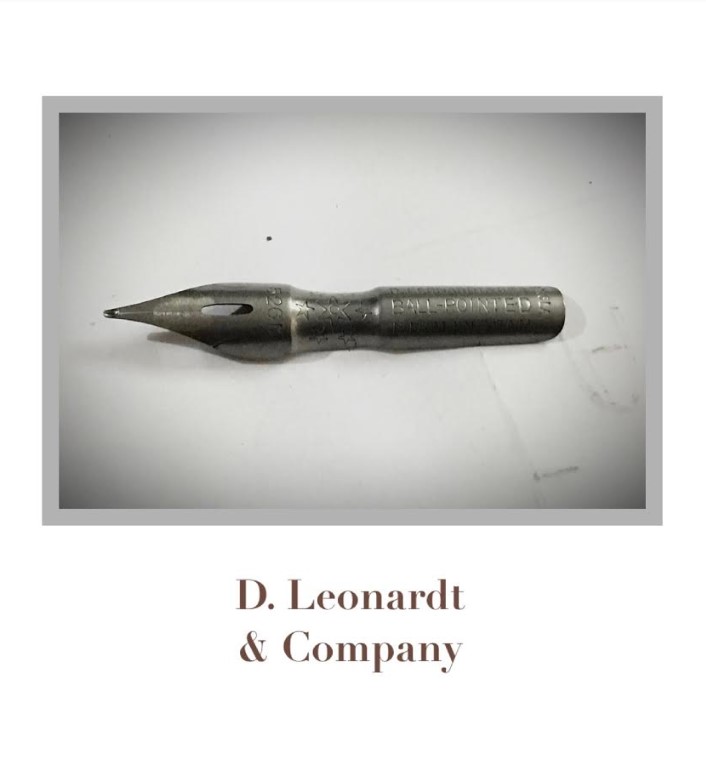
Leonardt Ltd. (formerly D. Leonardt & Co.)  was founded in 1856 by Diedrich Leonardt to manufacture dip pens. They had a large export market in South America and Eastern Europe, and produced pens for the King of Italy. The Co . Patented the  ‘Ballpointed ’ ( the nib with rounded tip ) and also a design named "Automatic Wonder Pen"- an early variety  of fountain pen in 1871.
Though almost all nib manufacturers closed down when the Birmingham boom burst,  , Leonardt & Co survived and  have remained in the industry although the company stopped producing nibs. They now make of metal components for stationery goods.

This heirloom “ Ballpointed” nib is made of nickle , according to their brochure.
——————-


 William Mitchell  started making pen nibs with his brother John Mitchell in the early 1820s and  established his own business in 1825 . The Company became  one of the leading nib manufacturers , famous for lettering pens.
100 years later,  the Company merged with Hinks, Wells & Co , Perry’s and other nib manufacturers to form “British Pens “.
The William Mitchell brand is still around making  art Calligraphy products .

-------------------------------------

MODELS 
Apparently, pen manufacturers vied with one another to innovate and bring out different Models of nibs regularly. 
The names on some of the models found in our family's collection are :
"Relief"  "Red Ink" and "New Metal" 
"Silver Wing , "Ballpointed" and "Pansy"
"Celtic" , "No.88M" and "Selected"
 --------------------------------

Other  items making up the antique  stationery  collection  are : 
PEN STAND 

Wrought Iron Pen  : Artistically made pen stands added a lot of beauty, 'atmosphere' and inspiration to a writing desk. There are a variety of Stands in the collection. This wrought iron sample holds eight pens. 
-----------------------

PAPERCLIP 

Macniven and Cameron Ltd. ( later : Waverley Cameron Ltd.) was a printing and stationery company  in Edinburgh, Scotland. The company was best known for its pen nibs, named “Waverley" nib which was unusual for having an upturned point, which made  the ink flow more smoothly on the paper. The "Waverley" was named in honour of  the Waverley novels written by  Sir Walter Scott .
The Company , which in its later years  manufactured  Paper Clips,   called “Waverly Clips" , closed down in 1964 .

—————————-
PENCILS

 Faber-Castell is one of the world's largest and oldest manufacturers of pens, pencils, other office stationery and Art supplies , luxury writing instruments and leather goods. It is Headquartered in Stein, Germany .
A.W. Faber, the original name of the company, is the oldest company brand in the USA.
The immensely wealthy Noble family were made Barons of Faber in the Kingdom of Bavaria in 1881. ( now, a State in Germany)
 Founded in 1761 , the Company , AW Faber Bleystiftwerke( = “Pencil
works”)  made pencils. The Founder’s granddaughter  married a Count of the Castell-Rudenhausen of N.Bavaria, in 1898. From them originates the new company name,  Faber-Castell. 
 This red and blue pencil carrying the “AW Faber” name is pre-1898.

There are also non branded lead pencils , "Made in Bavaria" .


This is a Copying pencil made by George  Rowney & Co. (Founded in 1783). The Company which was selling perfumes and wigs initially,  started dealing in  paints and Art materials in the 1800s . The Company later diversified into printing and publishing and is still in business .

--------------------------------------
INKWELL 


Inkwells can be great collectibles . The desk bound ones are in cutglass , porcelain and steel. 
"The Traveling Inkwell" : This Design seems to have been  in vogue in Victorian times . Glass bottle with  decorative brass top of tight fitting lid , encased in leather, colour coded ( black and red , according to the ink ) . Made in Austria .

-----------------------------------------------------------
INKSTICKS


Ink sticks or Ink Cakes are a type of solid ink (India ink) used traditionally in several East Asian cultures for calligraphy and brush painting. Inksticks are made mainly of soot or lampblack , carbon from charred pinesticks and animal glue or resin . the inkstick was ground against an inkstone with a small quantity of water to produce  liquid ink .

India ink was first invented in China, three millenia ago . But it was the English who gave it the name  Indian ink .
Indian ink, was also called Chinese Ink ! The sticks or cakes consist of specially prepared lampblack, or carbon black, mixed with a gum or resin .
For commercial use , a binding agent was also added to liquid Indian Ink , making it waterproof and permanent .
During Victorian times, regular liquid inks were also made from iron rust, tree gall etc.

 ------------------------------------------------------------
 SEALING WAX 

Sealing wax is a sealing material used on paper and parchment envelopes  , string or wire knots on parcels  which is difficult to separate without breaking . So it assures the receiver that the consignment was not tampered with before delivery. The sender's identity is usually stamped on it .

Sealing wax was made of primarily , Shellac ( or Laquer , araku ) , certain resins, chalk and colouring matter ( red lead  for Red ) . Other mineral colours were also used for green , blue etc . Shellac is a resin secreted by the Lac Bug , a native insect of India and Thailand.
Sealing wax was generally sold  in the form of sticks. The  stick was held to a flame and when its end started melting and dripping , applied to the closed flap of the envelope and stamped . It hardened very quickly .
---------------------------------------------------------------------
Postal Essentials


 People, back then, wrote long letters, some running into sheaves ! The household needed to be well stocked in envelopes and postage stamps .
 ------------------------------------------------------------------------
LETTER OPENERS 


Letters were not torn open in random fashion. It was a genteeel process, using letter openers !
Letter openers came in a wide variety of materials and embellishments.
Featured here is a Brass Letter-Opener with mosaic work  handle .
Mosaic is the art of creating a coherent design using small bits of colored stone, glass or glazed ceramics . The small bits are called tesserae . They can be irregular in shape or cut according to need and fixed into the base shape ( seen here in the reverse)  with plaster or glue .
Only the word “ Souvenir” is inscribed on this , so country of origin not known .

All stationery went into a chest of drawers or a roll top writing table . But there were times one  also needed to carry pens and stamps and clips to set up a writing space anywhere !


Tuesday, 14 July 2020

TILE TALE

Living in a 125 year old property , home to five generations of the family, can get surreal at times .
Because every scrap , stick and stone is older than you and has a long story to share .

Recently , my brother , with plans to redesign the garden , removed the terracotta tiles a pathway was
cobbled with . Since they were perfectly good tiles he washed and put them in storage for later use .
That is when he noticed the words on the reverse : “Basel Mission Tile Works Ferok " .

None of the words rang any bells . But he smelt History!

Our ancestral home , in Mysore,  was a vintage bungalow with many wings, subsidiary units and a huge garden with a tennis court . The architecture was typical of the times : open verandahs , tall pillars, high ceilinged rooms , monkeytopped dravidian roof and flooring of reddish brown terracotta tiles .
Dating from the first decade of the 20th Century , it has undergone periodic structural changes to suit the needs of the times.

The mainhouse was remodeled in late 1960s .
The Urban Ceiling Act of 1976 trimmed the original area , dematerialising the outhouse , a storage shed ,the cow barn and half the sprawling garden .
35 years ago, the last remaining annexe was pulled down, making way for an independent unit.
Through all these changes , many things have lingered on , saved or repurposed .
This lastmentioned annexe , by virtue of having been built a few years later than the main house , was
called “Puthu Veedu”and “Hosmaney” ( = New House )right upto its end .
Its doors, windows and dressed stones were all re-used in the new unit built in its place.
The terracotta floor tiles that could be salvaged in good condition were used for paving the garden
paths . There they blended gracefully with the soil , aging well , but staying fit .
These were the tiles that Brother pulled out while remodeling the garden .


The tiles gave us a name - “Basel Mission” - and compelled us to seek their hidden story .
Willingly , we dived into the great pools of information scattered in The Cloud to fish for snippets that could be sewn together as a backdrop for The Tile , a sample that now rests among the Family Memorabilia, while others will be re-used .

Here is that patchwork quilt of history that emerged from our quest .

BASEL MISSION

The Basel Evangelical Missionary Society, headquartered in Basel , Switzerland, was formed in 1815 by a group of German and Swiss religious men , as thanksgiving for Basel City being saved from Napoleon’s raid . “Basel Mission” for short , the Seminary trained Dutch and British missionaries to be sent to far flung places like Russia, Gold Coast , China , Cameroon, Borneo, Nigeria ,Latin America and Sudan on evangelical duty .
India could not be left out , of course .
The Mission sent its first three missionaries to India in 1834. They landed in Mangalore where they
learnt Kannada and Tulu and established a Kannada school (1836. ) Soon , with more missionaries , the Mission on the Kanara Coast expanded steadily.

Though the aim was evangelism , Basel Mission focused also on creating employment opportunities for local people in areas like printing, carpentry , brick making , weaving , horticulture etc . In order to train them in the necessary skills , the Mission inducted professionals from Europe regularly. Many
workshops and cottage industries were thus set up in and around Mangalore .

People who were part of this early phase of Basel Mission here have left lasting legacies , three of which merit mention .

Hermann Friedrich Mögling ,in charge of Basel Mission’s Printing Press ( estd. 1841) earned a Doctorate in Kannada , wrote and translated Kannada works and published the first ever Kannada newspaper Mangalooru Samachara in 1843. He is acknowledged as a pioneer in the world of Modern Kannada  Literature.
The Mission Press also printed the English-Kannada dictionary of Rev Ferdinand Kittel, along with
Malayalam and Tulu dictionaries and grammar books.

The colour KHAKI , which was adopted by the British as the colour for the Services uniforms , was
developed first in Mangalore by the German weaver and dyer,  Johann Haller ,  working in the Basel Mission weaving division , which , among other things, was also the first to introduce mercerised yarn. Haller prepared a dye specially for hunting suits , to aid camouflage in the jungles , using the rind of cashewnut tree and the heart wood of arecanut palm ( both found in plenty in the coast ) as ingredients to extract a hue resembling “the brownish yellow dust of the Indian road “ .
The colour was named ‘Khaki’ , derived from the Persian word ‘Khaak’ meaning “ ash / dust”.


An engineer named GEORG PLEBST ( aka Plebot) who was brought in by The Mission , to fine tune the type-faces for Kannada and Malayalam printing , looked beyond his brief and made a product that earned everlasting fame for the city where it was first made : MANGALORE TILES .

A mechanical engineer by profession , Plebst had also learnt pottery and glazing as a hobby . Clay
interested him. He found that the soil by the River Netravati was of excellent quality , naturally clayey ,high in mineral content and enriched by the alluvium that got washed down from the ghats . Clay was also found in abundance in the paddy fields . At the time of his arrival , a few Europeans were already experimenting with  laterite clay to make roofing tiles as they had found  the locally used concave tiles ('country roof tiles')  deficient in design.
Plebst decided to put his training to good use . He brought a set of moulds and screw press from
Germany , got the Netravati soil tested in Switzerland and Germany , developed drying frames and set up a workshop at Jeppu ( a locality in Mangalore) , making 500 tiles a day with the help of two natives . His pugmill ( mixer used for grinding and kneading clay into an elastic state) was turned by a pair of bullocks .

Tiles made by Plebst proved to be so good that a full fledged factory was started by The Mission in
Jeppu ,in 1865, with steam powered pugmills.
Basel Mission Tile Factory was the first Tile manufacturing factory to be set up in India . Hence the name Mangalore Tiles stuck and later, no matter where they were manufactured, that model of tile continued to  be called Mangalore Tiles. Its in colloquial usage even to this day.

The Tile business was a highly successful venture of the Mission.
Mangalore Tiles were nonporous , less prone to breakage , light-weight , interlocked and were the
wonder roofing of the day . They were enthusiastically marketed through British Trade channels and
became extremely popular .

The factory  very soon added other building essentials of clay to its list of products , like floor tiles , pipes ,ventilators, ridge tiles, decorative pots etc and the supportive English officers started recommending that only the products of The Basel Mission Tile Factory be used in all government buildings !
With Printing and Weaving also doing well, Basel Mission soon became the single largest industrial
entrepreneur in the region .

FEROK

The name Ferok is the shortened form of “Farooqabad” ( Town of Victory). It was the name given by The Mysore Sultanate for the new coastal Capital it set up in a small town near Kozhikode , when it occupied Malabar ( 1766- 1792) .
With Basel Mission  spreading out from South Kanara to North Kerala , it wasn’t long before a Tile Factory was started there too . The place chosen was Ferok . As in Jeppu , here too the soil was found perfect for making high quality clay products.
Ferok was always known for its timber , but after the first Tile factory was set up in early 1900s , it
became the byword for Tiles in Kerala . Till today , Ferok dominates the Tiles and ceramic wear industry in Kerala with dozens of factories . The Mission had added four more tile factories in other sites in Malabar to meet demand , but those  did not proliferate , down the years, in similar fashion .

“Basel Mission Tiles” made in Ferok were not only sold all over India , but also exported to Burma ,
Ceylon, Uganda , Aden, Basra , The Straits Settlements and Australia .

The Brand name of Basel Mission flew high till the second decade of the twentieth century. During
World War 1 , relations between The British, who had been major supporters , and Basel Mission ,
which was predominantly German , soured . It culminated in the British Government taking over all the ndustries operated by The Mission in 1919. Everything , including the Tile Industry , passed to The Commonwealth Trust Ltd, incorporated specifically for such takeover .
The factory at Ferok , as elsewhere , acquired the new name of Comtrust  (- a name that continues to the present-) and tiles were , from then onwards, stamped only with that name .

The label “Basel Mission Tile Works Ferok ” became History.


Illustrations
All photographs : Own
Portrait of Mogling , the Newspaper , pugmill : from public domain .
Drawings of Plebst , the Factory , collage of servicemen : Own

Thursday, 2 January 2020

Progressing, sheet by paper sheet.....

Visited TARAgram Orccha , a sprawling campus where it was heartening to see activities empowering rural women .

TARAgram was set up in  1996, in Tikamgarh district by Development Alternatives "eco-solutions for people and the planet" with the aim of creating new economic opportunities for communities using local resources , nurturing enterprises using innovative technologies, inspiring community based action and organisations.

The campus has many units for different activities, among them :
making building material from crushed stone waste,
making non-wood-pulp paper from cotton waste,
generation of renewable energy with biomass and agro-waste,
efficient management of water ,
and running a community radio station with 100% local talent.


TARA stands for Technology and Action for Rural Advancement .

At the time of visit,  only the paper making unit had begun work for the day. The unit has about 40 women of a very backward community, the Sahraiya tribe, handling everything from Alpha to Omega of the process .

Spoke to some of them and learnt that they now have a measure of financial independence and are are able to put their daughters in school . They work 7 to 8 hours with lunch and tea breaks and earn 150 rupees each, per day.

The raw material for making the strong paper is cotton  waste from the textile mills ( on that day, they were handling hosiery waste from Tirupur in Tamil Nadu )
The fabric bits were weighed and fed into the shredder ( at the far end)


The shredded bits were manually sorted and cleaned to remove any plastic or metal content .
The grinder , where the waste was reduced to a pulp.
Pulp treated with alum and churned and watered down . Colours ( organic dyes) are added at this stage . 
Pulp spread  over "mesh screens'  to required thickness.  The screen frames lifted to drain off  water. Only a thin layer of pulp remains on screen .
Then the screens were inverted over a fabric base , a weight put on it and the two women sat over the weight to press out all water . The women were wearing a plastic wrap-around below waist to keep their  clothes from getting wet !
With water squeezed out, the layer of pulp was peeled out and the non-woven fabric like paper sheets were hung up to dry.

                                     
The dry sheets were cut, jagged edges trimmed. 

Paper sheets were folded , glued and turned into sturdy bags...

...and other beautiful things like files,note books, lamp shades, coasters etc .
Since the initiative has Government support, the products, both as paper and as finished goods,  find a wide market through various emporia and corporate houses. Also exported.

Not only is it an employment opportunity for marginalised women, but the product itself is ecofriendly as it does not use wood . As per their claim :
One Tonne of  this paper saves 3 tons of wood and 100 Cubic Meters of water  which translates to :
6 trees , 3 years ofcooking fuel, 25 years supply of water for one person and needing only 1 sq.ft of land to dump the waste which is non toxic.

A lot of Feel Good energy was pervading the campus !
Left with a bagful of paper products and  a lot of positive feelings .

Inevitably, some doubts were raised : The major one being,  whether the women were being exploited in the name of  empowerment .
The paper products were not inexpensive. And, for sure, in city emporia and abroad, they would definitely cost more. To be charitable, the profits made are believed to be  ploughed back into making life easier for the village community.
When spoken to, the women seemed contented enough to have employment and steady income. The working conditions seemed non threatening .

Trust. Believe. And Hope.


Thursday, 1 August 2019

Venugopala is not moving again .


When mighty rivers are harnessed  by Dams, not only do geographical features and lives of relocated people change, the fortunes of enshrined Gods change too ! When flood threatens, you pack up and move.
This is the story of a beauteous Venugopala who just got too tired of transfers.

 Kannambadi (in local parlance)/ Caniambady (in EIC records)/ Kanvapadi ( in mythology), before the 20th Century , was a busy station by a ford which was an important crossing in the Kaveri valley for local life and commerce. The Hermitage of Sage Kanva was believed to have been situated here. The ford was used by the English Cavalry in their march to besiege  Srirangapatna . It was  also crossed by Tipu Sultan to attack Gen.Stuart, before his fall.

The little town boasted of two ancient temples : The Kanveshwara and The Gopalakrishna . The triad,  Kaveri-Kanveshwara-Gopalakrishna was revered as Ma Ganga - Kasi Vishwanath-Bindumadhava of the region.
Kanveshwara temple is attributed to 12CE , upon inscriptional data. .

The Gopalakrishna Temple was described thus by the renowned  Historian and Committee Head of Mysore Gazetteer, C.Hayavadana Rao , after a visit : "It is a large structure, 100yds by 60yds, being a mixture of Dravidian and Chalukyan styles. ....has considerable artistic merit and is enclosed by two prakarams .Around the inner prakaram are 46 shrines that house the 24 murtis and 10 avatars of Vishnu, besides Brahma, Saraswathi, Harihara, Hayagreeva,Jalasayana and others , with their names engraved in Hoysala style script on the lintels....This temple is said to have been  enlarged by Narasaraja Wodeyar , son of RajaWodeyar....Inscriptional evidence points to renovation work also done during  Veera Ballala III 's reign.....the Gopalakrishna, which is a later addition, is a finely worked image."

Veera Ballala III, last Great King of the Hoysala Dynasty , ruled from 1292 to 1342 . So the temple must have been in existence from before 1300CE.

Cut to HosaHolalu ,not too far away,  in Mandya District . The grand Lakshminarayana Temple here was built by Veera Someshwara in 1250 CE . This Hoysala gem closely resembles the famed Somanathpur temple, in art and architecture. The south cell of the tricutachala temple once housed a wonderful  icon of Venugopala aka Gopalakrishna.

When Narasa Raja  Wodeyar saw this Venugopala, he decided he had to have it closer home and   carted it away to be installed in the Kannambadi Gopalakrishna temple , which he was renovating and extending. Well, he was The King , after all, and could have his way !  But then,who  can resist falling in love with such a splendid piece of art !
 

 Then , in early 1900s came The Dam.
The KrishnaRajaSagara Dam was a great project but it necessitated inundation of 44 villages that lay across its blueprint . A massive relocation work was undertaken.
All natives of Kannambadi town - human, bovine and divine - were  shifted to a newly created hamlet, close to old address but on safer ground. It was  aptly named Hosa  Kannambadi . Hosa =New.
 Icons in worship were saved, the edifices were not.

People acquired humble new homes as compensation for their humble old homes ; the Gods acquired humble new shrines as compensation for their magnificent old abodes .

Upon completion of the dam , three temples of Kannambadi went under water :
 The Kanveshwara Temple , The Gopalakrishna Temple and the relatively younger Lakshmi Devi Temple.All their worshipped murthis were duly consecrated  in newly built shrines.

Of the three old temples , only the Gopalakrishna temple  was dredged out and rebuilt on the bank of the reservoir by the Khoday Distillary Company  in recent years . The salvaged temple is impressive but remains an empty curio . Venugopala stays put in the Hosa hamlet, though the reborn temple is called Venugopalaswami Temple, in his honour !

He is not tempted. He had already moved once , from a grander house in Hosaholalu. No more moving. Time to settle down in peace.

Peaceful it is, in the little hamlet, beyond the Reservoir. The  new temples built for the relocated Gods are simple ,unpretentious and  cosy .
No one who enters the Venugopala Shrine is ever prepared for the stunning vision that will greet them inside the bare room. 

The stele of Venugopala , installed in the left cell as we enter, is carved out of black schist , polished to a high degree of smoothness. Gopala is a youthful figure , standing under a lush , leafy tree, said to be Honge ( pongamia) .


 All around him are his friends and admirers apparently enchanted by the divine music pouring forth from the flute of the Divine Cowherd.


Along with shepherds ,  cows , squirrels and birds too wriggle into available space adding life to the tableau .


(Gopikas)


( Divinities in attendence)

The sculptor must have been in some kind of a spiritual trance to have translated that dreamy scene so  intricately into stone art .

             (The Dashavataras , worked  into the border .)


( The  adoring cows and a companion )

( Not forgetting the little monkey on the treetop)


 ( The humble village Shrine at Hosa Kannambadi)


 (The drowned temple , dredged out and rebuilt on safer bank ,behind Krishnarajasagara Reservoir ).

Venugopala seems happy in his little  cell , where a dedicated priest showers him with love and care twice a day . Stray visitors, who do not expect to see such a splendid sculpture in such a humdrum shrine , bow down to him in awe . That suffices .

He plays on to the enchantment of the numerous little attendants who surround Him on the stele , keeping him eternal company , from Hosaholalu ....to Kanvapadi .....to HosaKannambadi .


( HosaHolalu , in Mandya District, that was His original home.)


     Settled and not moving again  !......Madhuradhipate Akhilam Madhuram

_____________________________________________

 All photographs are mine.

References:
Site visits ; Oral  history collected on site.
Mandya District Gazetteer - Govt. Of Kar.
Mysore Gazetteer Vol.5 - C.Hayavadana Rao.
Epigraphia Carnatica Vol 3, 6
Karnataka Itihasa Akademi articles.


Saturday, 4 May 2019

Forgotten Games of The Girl Child

Some GIRL GAMES played in The South that have almost disappeared : 
These days , there is a revival of interest in the traditional games of our country and its heartening to note that many clubs have sprung up to teach board games like Aadu-Huli atta , chowkabara , Paramapadam , Mancala etc. to the present generation . 
For lack of safe playing spaces , today's children are not able to indulge in Gilli-Danda , Lagori , Kuntobille etc. and it is understandable that these games have faded away from our lives. 
While Board games are for all children irrespective of gender, there were games specifically enjoyed by the Girl Child , which are not being popularised as much currently. 
Those girl-games were gentler , entertaining , often involving ditties / folksongs and needed hardly any supplies or space to play. 
The games were not confined to specific regions . Variations of the basic themes were spread everywhere. So also , the songs that accompanied girl games were varied and numerous.

Word Association : ( Kannada) 
One very popular game involved word associations . 
It was in Q and A format , taking one word of every line and asking a question about it : "which/ what " . 
The answer would be another ( associated) word .
Mothers and older girls could make the sequences longer and harder for the little ones to come up with apt words. 
The song was accompanied by striking/Clappping of each others hands in a certain pattern , keeping beat with the syllables of the verse.
“Acchacchu . Belladacchu .
Allinodu . Illi nodu . 
Sampangi maradalli gumpu nodu .
Yaava gumpu ? Kaage gumpu .
Yaava kaage ? Kappu kaage .
Yaava kappy ? Ijjila kappu. 
Yaava ijjilu ? Soudey ijjilu .
Yaava soudey ? Kaada soudey .
Yaava kaadu ? Sudugaadu ! 


 Guessing Game ( Malayalam ) 
Any small rounded object ( seed , button , berry , bead, cowrie ) was enclosed within both palms ( box-like) and the closed hands were waved , rolled about, shaken.....
All the while the girl sang :
" Akkaiyil Ikkaiyilo pazhukka , ponnappan trikkaiyilo pazhukka ..."
( Pazhukka = ripe areca fruit ) 

"Is it in this hand or that hand or the Lord's ? 
Undetected , soundlessly it leaves for the First bridge/ step " 
At the end of the stanza , the girl separated her palms quickly , made fists and asked the other to guess in which hand the object was hidden. Quickness of hand was needed . Also ,a quick eye to detect the hand movement . 
The song went on to the second stage , third stage , after which , if not guessed right , a forfeit was due.

 Treasure Hunt .( Tamil ) 
Best played by river banks / sea shore . 
An elongated mound of sand was built . One girl held a slim object ( twig ,coin etc) between the thumb and index finger and ploughed it into the mound , running the sand-covered hand from one end of the mound to another, three or four times . She would drop the object anywhere , deep inside , anytime, but kept running the hand till end of song . When song ended , the other girl interlocked the fingers of both hands as a " net " and put it down where she guessed the object was. The mound was destroyed to find out if she was right . And built again for the next round. 
Interestingly , the song " Kichu kichu Tambalam, kiyakiya tambalam" has no meaning at all ! 
( perhaps a corrupted form of some Senthamizh ( OldTamil ) poem , no idea)

Rap and Snap ! ( Telugu ) 
Fairly universal . Known better as Knucklebones or Astragaloi .
A game that can be played alone or with any number of others . It involves doing two things together : singing and juggling pebbles . Five pebbles each . Lay all on floor , toss one up in the air and before it lands , pick up one/ two of those on ground and catch the falling pebble before it hits ground , toss up again , collect the rest .....and keep rapping ! Any rhyme is good enough . 
One much loved song was about the wedding of Mr.Monkey ! 

Kothi baavaku pellanta
Kondaa konaa vididhanta
Kukka nakkala vindhanta
Enugu vaddana cheyunanta
Elugu vintha choochunanta
Kodi, kokila, kaakamma

Kothi pelliki paata anta

Vaara Annam


This was a brief phenomenon , lasting , at the most , for just three or four generations in South India . Still , as a memory of a small vignette of long dead social mores , its worth a note .

Imparting education , before advent of European modes of schooling , was almost similar to adopting the pupils . The boys lived with the Guru in his home , not just learning from texts , but picking up life skills as well . Western system of education brought instituitions like High Schools and Colleges and these early temples of learning were situated in Cities only . Boys from small towns and rural areas , desirous of earning college degrees , had to migrate far from their homes and families and fend for themselves in strange big towns . 
Choultries and hostels provided shelter , but food was a major problem . Hotels were few and expensive for poor students . It was in this atmosphere that a philanthropic notion found root . 
"Anna-dana" has always been regarded as a great Virtue and people were ready to help these displaced Students out of a sense of Dharma . 
Each community , through the tribal grapevine , reached out to migrating students of their own kind and took up the responsibility of feeding them . 

For the wealthy , who lived in Manors populated with extended families and retainers , a couple of extra mouths to feed hardly mattered and they "adopted" two or three students , wholesale , to be fed everyday. But the ordinary folk did not lag behind in contributing their mite. A system was worked out whereby one student would be fed , by turns , by different families on different days of the week , so that no one family felt the strain on resources. This system came to be called " Vaara-Anna " ( ವಾರ ಅನ್ನ ) in Kannada; "Vaara -Sappadu "( வார சாப்பாடு ) in Tamil . It worked like " If its Tuesday , it must be Thimmappa's" . 

One funny offshoot of this arrangement was the appellations the boys earned. Often their names were prefixed with the name of the weekday they came to dine ( eg : Budavara Somu ) . Sometimes , even the name was omitted and a boy could end up being known as just "Sukravaram " ! 

Many students from impoverished backgrounds owed the bright future their college education brought them to the kindness of unrelated people who fed them on the Vaara-anna routine . Strong , long lasting bonds were forged between the donor and donee , becoming the standard fixture of nostalgia for many achievers who came up the hard way . 
The Vara Anna tradition continued right upto mid 20th century , dying out totally in the early sixties 
when educational institutions , with affiliated hostes , started sprouting in smaller towns too and Hotels and Cafes proliferated everywhere . 

(representational pic)
The last batch of Vara Anna beneficiaries would now be very senior citizens and may remember with fondness the strange times when they ate as guests of seven families !

"A Gallery of Indian Domestics"

 Having domestic help ( "Servants" ) is considered feudalistic these days and the practice lingers on only in pockets of third wor...