Sunday, 4 April 2021

"A Gallery of Indian Domestics"

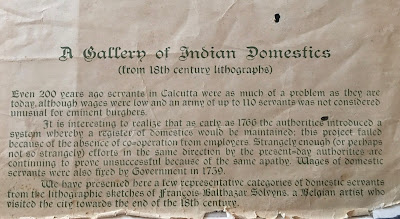
 Having domestic help ( "Servants" ) is considered feudalistic these days and the practice lingers on only in pockets of third world countries. 

But , once upon a time , in bad old days, it was considered a mark of one's success to have many people looking after the many departments of running a household. Especially in Colonial days , the colonisers had small armies of natives serving them . The pale skinned man could have been from a  riffraff background back home in England , but here , in the Colonies, he could lord it over as a White Nawab . Any wonder the land attracted fortune seekers in droves, never mind the heat and dust !

One thing to be said in their favour :  the Colonisers kept meticulous records of everything they saw and experienced in the colonies . The illustrators ( painters, lithographers, engravers) did a good job of preserving for posterity scenes from their day (save a fanciful misrepresentation here and there ).

The  battalions of Servants and their classification merited recording too. In late 18th Century, a Belgian print maker   named Francois Balthazar Solvyns ( 1760 - 1824) came to India to make drawings of  life and living  in Calcutta and worked here for 13 years . He is considered one of the pioneers of Print Making in India. 

 His first published a collection of 250 etchings  titled A Collection of Two Hundred and Fifty Coloured Etchings: Descriptive of the Manners, Customs and Dresses of the Hindoos ( Calcutta, 1796.) Unfortunately, it did not make money. for him  He returned to Europe, became a diplomat, reworked his etchings and published "Les Hindoos" . This set is considered the model for the "Company Style" of Art that developed and flourished later in India. 

Calendar Art , in India , is a genre by itself . Though gaudy, glossy offset prints of Gods and Filmstars were most ubiquitous on calendars , some establishments took pride in publishing good art work too. Ofcourse, at the  present digital Age , it is not known if any pains are taken by anyone to make beautiful calendars that doubled as wall displays  once. 

Long ago, an Insurance company or some Bank( I do not remember) had brought out this calendar featuring Solvyns' gallery of Domestic helpers. It was too lovely to be discarded  with old newspapers at year end, so it stayed back. With the date part cut away, and the side stapled, it looks as good as an art book. And I had saved it for almost 45 years. Couldn't bring myself to throw it away. Inspite of periodic spring cleaning sessions and house-moving , the "folio" remained with me, either stored under bed or at the bottom of the bookshelf . Its odd size was always a problem and the edges were always curling and fraying. 

Eventually, Age and Time catch up. It is no longer possible to retain the Folio  in good condition, nor is there the desire to hold on to it any longer . It's time to let go of things.........

But not before this shot at digitizing the old favourite ! 


SARKAR : A house steward , a genius whose whole study is to handle money and to keep household accounts. KIDMUDGAR : Served meals and waited at table . 
KERCH BURDAR : Carried the loose cash for the Master and was in charge of buying small things such as fruit for the household.
AUBDAR : Looked after the cellar and kept the wines cool.
HOOKA BURDAR :  arranged the hookah for the Master after meals and hovered around till end of session.  BAULBER : The barber who shaved the Master . Only shaved, did not do hair dressing. HIRCARA :  personal messenger  or courier . 
CHOKEEDAR : Private WAtchman who paraded around the house with sword and spear till everyone was asleep. COACHMAN : chauffeur 
MUSHAULJEE : Torch bearer who ran with a lit torch before the Master's carriage , after dark. CHOWRY BURDAR : carried the chowri ( Yak Tail whisk), an Insignia of Rank,  in front of  the Master . KHAUNSAMAUN : Chief butler and Waiter at table. 


Thursday, 25 March 2021

An Old Curiosity Palace

 Suan Pakkad Palace  is a lovely little  haven , nestling in tranquil detachment, in Sri Ayutthaya Road, Bangkok, not far from Phaya Thai BTS Station.  It is not at all as flashy or huge or even well known as the other Palaces in Bangkok and consequently, not crawling with tourists. In fact, the day we visited, it was just us !

The surreal phantasmagoria of  Alice's Wonderland is what comes to mind the instant you come to know that the name of the Palace, Suan Pakkad,  means  "Cabbage Patch" ! Really ! 

Well, the place was really a cabbage patch before a prince and his bride inherited it during the  1950s and decided to make a residence there for themselves. Scions of Oriental Royalty have their quirks.  Instead of building anew, they had four antique Thai houses uprooted from elsewhere and got them assembled in this compound , with lush tropical gardens laid around them. 

The best among the repurposed houses is  The Lacquer  Pavilion (above ), a 17th Century wooden house on stilts, completely covered with lacquer, embellished with gold inlay murals of the highest order depicting the Life of Buddha and scenes from the Ramayana . Visitors are allowed to enter and gape, but strictly no photography. In a courtyard by this pavilion stand a large ornate, gilded barge used by King Rama V .

Later, more Houses were constructed around the core of these four. 

The 'No photography'  rule applies to all rooms of the Palace, which is now a Museum . The Prince and his Princess, it seems, were avid collectors of beautiful and interesting objects and their Palace is crammed with their collections. While collecting gave  personal satisfaction, the royal couple decided that sharing  their collection with Public would enhance that pleasure because after all, whatever they collected was also common heritage of all mankind. Hence, conversion of Palace to Museum. No longer a residence.


Two huge brightly painted cement Roosters welcome visitors to the Museum. At the reception area, where tickets are sold, the staff is very polite, friendly , almost making it seem like your visit is a honour to them ! Talk of old world etiquette ! 

Along with the ticket we receive a handy visitors guide brochure and a woven palm hand fan ! A polite , uniformed attender is dispatched as our personal companion to guide us and to unlock doors.  He  may also keep an eye on visitors who are tempted to help themselves to souvenirs on the side ! Its really easy, because many  exhibits are small and kept in open display .

The first artefact of interest to be pointed out is the "horoscope" or The foundation Stone of the building, an engraved stone slab embedded on the wall of the entrance corridor. 

The houses are interconnected with  raised walkways and we go house hopping.

House 1 displays a wide range of musical instruments of all kinds at the ground floor. detailed notes are found alongside each. The upper floor has beautiful statuary /figurines of stone, metal and wood from different eras of South East Asian history. Buddhas aplenty, ofcourse ! And a very lovely  headless Uma and an Ardhanariswara , probably Khmer. 

House 2 : The ground floor was reportedly nicknamed Alibaba's Cave by the Princess because it contains a variety of rare and valuable rocks and minerals , so colourful and twinkling under the lights.The Upper Storey is filled with miscellaneous curios like traditional furniture , cabinets, containers , trays , boxes , fans etc which are richly worked and painted with delicate designs so typical of Thai art. 

House 3 : The elegant paraphernalia of Thai royalty , like the parasols,  a model Throne ( Busabok), palanquin and formal insignias are all found here. At the Upper level is a vast collection of Bencharong, the unique China made pentachromatic ( pancha-rang) porcelain with customised Thai designs. There are also some Gold and Silver neilloware artifacts .

House 4 is still in use for royal receptions and dinners. And it has their private chapel also. Visitors are allowed , when it is not in use. There are quite a free Buddhist paintings and  mother-of-pearl inlaid panels. 

House 5 has more rocks and minerals, along with great looking Fossils personally collected by the Royal couple. They sure had eclectic tastes ! 

House 6 is the Khon Museum. Khon is the Mask used in the traditional  opera which uses both dance and story telling formats. Stories are always from The epic, Ramayana. Each mask has a character, is elaborately made and visually stunning. In this museum , it is possible to see a diorama with action figures ( Khon puppets) enacting scenes. 

House 7 : stores prehistoric artefacts obtained from excavation around the country,  Chinese ceramics from Ming, Song and Yuan dynasties, Khmer pottery and  Green Glaze friezes from Burma. 

House 8 is dedicated to household items - glassware, silverware, porcelain, crystalware- used by the Royal couple who tuirned such prodigious collectors .

Marsi Gallery exhibits the paintings of the only daughter of the couple, who was an artist.The Gallery is also rented out now to contemporary artists to show their work. 

The pride of place among this odd collection of things in this museum , belongs to The Banchiang Collection, housed in a modern annexe. 

Ban Chiang , an archeological site in North East Thailand, that yielded amazingly sophisticated artefacts of ceramic and metal from an unknown bronze age civilization , was discovered in 1966 and has been a World Heritage Site since 1992.  Initial dating had declared it to be the earliest Bronze Age civilization in the World. But later dating with better techniques brought the date down by wo millenia to about  2100BCE  . The settlement could have flourished upto 200BCE.

While the exquisite painted pottery pieces , many of them intact, look like they were made just yesterday , the bronze objects like bracelets, rings, spearheads, axes, blades and bells, show very fine workmanship. One exhibit is a bony hand still wearing  a large spiral bracelet and, with clay around it, it looks eerie. The pottery pieces are of different elegant shapes and painted in a swirling pattern , which give them a modern look. 

Before the site was formally discovered, local villagers are said to have just picked up ancient pottery and metal pieces for their use from the wasteland ! And after it became famous, it attracted looters who saw a good market abroad for the grave goods stolen from  here ! The collection in Suan Pakkad palace is quite large and gives a good idea about the high degree of refinement and culture attained by those ancient people , about whom studies are still in progress both locally and abroad, most notably in Pennsylvania University.


Pictures of some exhibits from the brochure : Model of the Throne , A Sukhothai Buddha, a conical food container, a Khon Mask and a Banchiang Pottery 


Wednesday, 20 January 2021

Guardians of the Directions

Propitiating a force of Nature or a Natural Phenomenon , observed to affect human life in some way, was one of principles of early Religiosity or Spiritualism . To be surrounded by or enveloped  within  the benevolence of  these Forces was a much desired goal and installing a "divinity" as a Guardian  in every direction ensured a sense of security . 

Guardian spirits were assigned to the four cardinal directions and the four intermediary directions and early structural temples usually depicted them  on the ceiling , in a grid surrounding the presiding deity . Two more directions, Upper and Lower or Zenith and Nadir , called  Urdhva and Adhah in Sanskrit guarded by Brahma and Vishnu respectively, are omitted from the grid. The Dikpalas are depicted as male and with their preferred mount . In some sites, the panels show them accompanied by consorts. 

In Karnataka, Temples built by the Western Gangas and Nolambas  have very finely worked bas-relief panels on ceilings dedicated to the Guardians . The best Ashtadikpala ceiling grid , anywhere in India, is found in a humble , unpretentious shrine to Kalleshwara in Aralaguppe, Tumkur District . It is a Nolamba masterpiece . 
The Hoysalas made large , ornate sculptures in the round and placed them on the walls alongside other deities. Later , during Vijayanagara times, the Guardians came to occupy frames in the lower portion of pillars . 

These are the Dikpalas ( Ashta-dik-palakas = Guardians of the 8 Directions) carved on the ceiling of Bharatalingeshwara trmple in Avani, Kolar dist. Creation of the Nolambas . 
The central panel shows the DivineFamily : Shiva, Parvathi and Ganesha, with Nandi under  Shiva's foot. 

1. Indra guards  East . Indra's  vahana is Iravatham,  the White Elephant which is symbol of royal strength. The attribute he carries is the Vajra ( thunderbolt) and his Consort is Sachi .

2. Varuna guards 
West ( Pascima or Pratici in Sanskrit) .His vahana is Makara , a stylised crocodile or an aquatic dragon. His  attribute is Pasa ( the Noose) and his Consort is Varuni.  


3. Kubera  guards North ( Uttara or Udici in Sanskrit) . The vahana of Kubera is Nara (Man) , Horse or a even a Goat. It varies by region. His attribute is Gada ( the Mace) and his Consort is Bhadra . 

 4. Yama guards South( Dakshina in Sanskrit).  His vahana is a  Water-Buffalo. His attribute is Pasam ( ropes) and his Consort , Dhumorna. 

5. Agni guards  South East ( Aagneya in Sanskrit) . Agni , who can also be depicted as having two faces, rides a Ram and his attribute is Danda ( a staff) . His consort is Svaaha. 

6. Nirutti guards Southwest ( Nairritya in Sanskrit)  . Nirutti ( aka Nrtti or Nairutta), called overlord of the Demons , has for a Vahana , a Man or Ghoul . Though generally shown in art as a male, Nirtti is also known as a form of Parvathi . a female Dikpala. The attribute is Khadga ( Sword) . 

7. Vayu guards Northwest ( Vaayavya in Sanskrit). Vayu's vahana is a Deer . Attribute is Ankusha  (a Goad) . Consort is Lehari . 

8. Isana guards Northeast ( Ishanyain Sanskrit). Isana has Vrishbha (bull) as his vahana . Attribute is Trishula ( Trident) and Consort is Ishani. 

Depictions down the ages : 

The entire ceiling grid , with the Jina as central panel, at Kambadahalli Basadi - a creation of Western Ganga artisans. At the four intersections are seen celestial musicians . 9th Century CE. 


A large sized Hoysala example from Kedareshwara Temple, Nagalapura. Varuna , with Consort , riding the Makara ( mythical aquatic animal ) , as a niche figure on the outer wall.  In addition to having the Guardians in ceiling grids , the Hoysalas also  magnified the Guardians and arranged them on the outer walls , on par with other figures from Mythology . 13th Cent CE.


A post - Vijayanagara period depiction of  bicephalous Agni riding a Ram, as a pillar decoration , in the octogonal pavilion by the temple tank in Melkote. The other Guardians occupy other Pillars , at their relevant direction. 16-17th Cent CE. 


More recent , as Wodeyar period Stucco figures , arranged on the outer walls , each in own niche : Niruttti , Yama and Agni , in Srikanteshwara Temple, Nanjangud. 18-19th Cent CE.


Thursday, 14 January 2021

Vibrant Street Art

What is the best way to cheer up a dreary neighbourhood ? 
Splash  bright paint all over the walls and add Artwork anywhichway you like . 

Colours do have an uplifting effect . We read magazine articles on how a slum in Indonesia or Brazil got a facelift with just 10 cans of paint . Not merely facelift. In certain cases, the paint changed the fortunes of the slum for better, making  it  photogenic enough to draw tourists ! Advent of Tourists is good news for small businesses ranging from water bottle vendors to trinket sellers to Guides. 

Rows of colourful houses - the colours often clashing, not necessarily harmonious but making for very good pictures - have become tourist attractions , from Burano(Italy) to Nyhavn ( Copenhagen) to Kampung Pelangi ( Semarang, Indonesia) ......

Our Cities too went after Beautification with buckets of paint , but the emphasis was on Artworks . Ok, some employment for art graduates. Street wall art is fairly widespread now, can spot them everyhwhere . 

Visiting Kochi ( Kerala)  right after the Muziris Biennial 2014 had given  us a lot of public wall art to "collect". 
"Guess Who" was there, with those signature portraits , so resembling Banksy's work. 

Here's an assortment : 


Friday, 30 October 2020

A PRINT , A PAINTER and A PICTURE SELLER


  This Oleograph  was hanging  in the approx. 160 year old ancestral manor of  the Seeplaputhur Family,  in  rural Tamil Nadu , facing the prospect of becoming food for termites.

.....Now rescued from definite ruin , cleaned up and given a prominent place in the Bangalore Apartment , as befits an heirloom .

An heirloom with a little history attached to it. 


Caption : "Murli Manohar"

Artist : Narottam Narain of Nathdwara

Published by : SS Brijbasi and Sons , Bunder Road , Karachi

Printed in : Germany 

A registered copy. 

It was a  trend during the first half of the 20th Century for households to have such prints on their walls. Many middle aged people today will remember having seen similar pictures of deities in their ancestral homes . Some dismiss them as Calender Prints. But they not old calenders. They are special prints that brought about a silent revolution in how we imagine our Gods , bringing  forms that were  till then mostly confined to Temples  closer home.

When Indian Art , that followed  traditional canons , was introduced to  the Western idiom of realistic painting during 18th  – 19th centuries , there was  a sea change in how religious themes  came to be picturised.

Nathadwara , in Rajasthan, was renowned as a Centre of Artisans .  

Narottam Narayan Sharma of Nathadwara ( 1896 - 1992) was an extremely popular and influential painter of divine images , trained in the traditional fashion ie, drawing flat illustrations on scrolls and screens meant for worship. But, impelled by the modernism that had crept in,  he took to  the Photo-Realism genre to give Gods an " empathetic presence " , bringing them closer to the devotees. He became famous for his paintings of Krishna and this particular painting "Murli Manohar " ( painted in 1934 ) is reputed to be the best selling image  in the history of Oleographs in India . At a certain point his paintings  were  more popular than those of Raja Ravi Varma . 

The very first image of Shrinathji of Nathadwara temple to ever get printed was painted by Narottam Narayan . This event ( of 1928 ) caused a major controversy as the temple guardians feared such easy availability of God's image would affect pilgrim traffic to the temple and dent its earnings ! Eventually , however, it turned out to have the opposite effect , bringing more visitors  to the temple ! Since the prints were distributed all over , more people than would normally make a pilgrimage to Nathadwara  could get a glimpse of the Lord , thereby developing interest in seeing the actual Icon in the Temple. And those who did travel anyway, were happy to bring back a print for their own wall. A Win-Win situation. 

 Narottam's paintings of gods were all mass printed by the popular Karachi based publisher SS Brijbasi and Sons ( " Picture Publishers") who got  their all printing done in Germany,  until Partition happened. Later , the publishing house ran its own press in Mathura, Bombay and Delhi ...and in recent times , in Sivakasi too ! But , Oleo is no more . Offset printing  had captured the industry.

 Oleography( or Chromolithography ) invented in Germany in late 18 th Cent. , revolutionised the way Indian people related to Gods.

Traditionally made pictures of gods were always around . But they could not be obtained unless specially commissioned , hence they were out of reach for most ordinary people .

Oleography was a gamechanger .  The technique  consisted of multi layered lithography , using oil based inks . Excellent effects could be achieved in this method.  These prints were not only very attractive and brilliantly coloured , but were  inexpensive too.

It was large scale "democratisation " of Religious icons .

The oleo colours of this picture are still vibrant ! Brijbasi's 1933 catelog seems to have boasted of "akarshak rangon " and " gazab ki chamak " of their prints from " Jermani ke mashahur kharkane se " 

....No empty boast !

______________________

NOTES : 

1.Oleograph, also called chromolithograph or chromo, colour lithograph produced by preparing a separate stone by hand for each colour to be used and printing one colour in register over another. The term is most often used in reference to commercial prints. Sometimes as many as 30 stones were used for a single print. The technique was pioneered in the 1830s but came into wide commercial use only in the 1860s. It was the most popular method of colour reproduction until the end of the 19th century, when more efficient techniques rendered it obsolete. (Brittanica)

2. In the Lithographic process, ink is applied to a grease-treated image on the flat printing surface; nonimage (blank) areas, which hold moisture, repel the lithographic ink. This inked surface is then printed—either directly on paper, by means of a special press (as in most fine-art printmaking), or onto a rubber cylinder (as in commercial printing).The process was discovered in 1798 by Alois Senefelder of Munich, who used a porous Bavarian limestone for his plate (hence lithography, from Greek lithos, “stone”). ( Brittanica)

3. Offset printing, also called offset lithography, or litho-offset, in commercial printing, widely used printing technique in which the inked image on a printing plate is printed on a rubber cylinder and then transferred (i.e., offset) to paper or other material. The rubber cylinder gives great flexibility, permitting printing on wood, cloth, metal, leather, and rough paper. An American printer, Ira W. Rubel, of Nutley, N.J., accidentally discovered the process in 1904 and soon built a press to exploit it. (Brittanica)

Thursday, 29 October 2020

Vegetarian hunt in Russia

 The World has flattened, distances have shrunk and people have migrated all over , so cultural differences are not all that big these days. Being a vegetarian was once a mighty big inconvenience when traveling overseas . It is no problem at all now as Vegetarianism is well embraced everywhere and has also grown its own sub-fads like Veganism , Ketodiets etc . Finding "rabbit food" ( as it was once trolled) is not difficult anywhere  now. 

Still , had a tiny prick of anxiety about Russia , because so little is discussed about food choices there .

A quick reading up revealed Russians are not great lovers of Vegetarian food and other than a stray potato or cabbage salad, most cafes  may not have much on offer. 

Not to panic ! Georgian cuisine to the rescue ! 


The Georgian restaurant we enjoyed eating in  , in St.Petersburg . “Phali Khinkhali” .

Its logo is a khinkali fluttering on tiny wings . Khinkali , dumplings with stuffing of choice , is the quintessential Georgian food which we never got to taste - to our eternal regret . Each meal is served course by course and portions are humongous . By the time we had munched through the starters and appetisers , we were overstuffed and had to wave away the dumplings . Had to save space for the pudding ! It happened in both the Georgian restaurants we visited, so no taste of Khinkali , sadly ! 

But plenty of other flavours and textures  to remember:


1.Cucumber , Onion and Tomato salad , dressed with ground walnut, lime and olive oil . ( walnuts are used extensively in everything )

2.Pkhali (minced vegetables, served moulded like colourful idlis : spinach , cabbage , beetroot ,seasoned with garlic , herbs and powdered walnut . )

3.Badrijani : grilled slices of eggplant ,covered with thick walnut-garlic paste and rolled up . Served cold with cilantro/ parsley .

4. Ajapsandali : a kind of ratatouille consisting of aubergines, tomatoes, mushroom , potatoes and red pepper, seasoned with garlic and herbs.

5. Mchadi are small, crispy toasties made of cornflour, milk and water. Served with cheese.

6. Lobio , a dip made of white beans , walnut, garlic and herbs .

7. Khachapuri : a Georgian staple , the "cheesy bread" . Something like naan/ pita filled with cheese. Some cheese is added as topping too. BTW , puri means bread in Georgia !

8. Ajika : a kind of spicy pesto made of red peppers . Goes well with the bread .


A mash of stewed vegetables tasted very indian. Reason : The all purpose , mixed spice powder  they use (Khmeli-Suneli) , resembles our garam masala .Ingredients : coriander, marigold, fenugreek, dill, mint, parsley .

 Desserts : 1.Baklava . Sinful , crunchy Puff pastry stuffed with pounded nuts and sugar .

2.Pelamushi : delightful pudding made of grape juice, wine and cornflour . 


Trdelnik .

The one Russian snack we tried, in a cute kiosk outside a Basilica .

A sort of funnel cake , made fresh upon order . Crisp at first bite , it loses the crunch very soon , but a treat nonetheless . The girl in the kiosk dint speak English , but the sign boards were helpful.

So what is a Trdelnik ? A hollow pastry of Czeck-Slovak origin. It which is cooked a special way , on a spit , like kebab .  The dough , cut in ribbons, is wrapped around a wooden cylinder , sprinkled with sugar and baked over open flame with frequent turning of the cylinder  . The hot pastry is  slid off the cylinder when the sugar on top caramilises  into a shiny , crisp crust . It is best eaten hot/warm  , right off the oven. The pastry  can be plain or kneaded with olives , nuts etc. Sugar is omitted if so desired. 


And of course , no escaping desi fare ! We certainly dint go looking for it , but just stumbled upon a cafe called “ In Jagannath We Trust “ that had , in addition to  beverages , some non-spicy , non greasy Indian foods sans onion and garlic. The picture  above shows one of the posters on the wall of the cafe. No idea what it says, though ! 

No , not run by ISKCON , but by another Vaishnava Trust  .


No dearth of fruits ! A local market where everything looked fresh and delicious . 

Outside one of the Cathedrals where tourists throng . 


Tuesday, 27 October 2020

The Romance of Russian Scarves

 When looking for souvenirs  to take home from Russia , the tourist can drown in the flood of Babushka nesting dolls . They come in all avatars , in all price ranges , of all materials and also printed on  all possible things, including the very attractive shopping bags in which souvenirs are packed for you. They are pretty, true, but very predictable .

The second most popular souvenir is the Scarf . I dont know if that is predictable too , but I did fall in love with them . ( And yes, The Babushka dolls wear scarves too !) 

(The Souvenir Carry Bag showing Babushka Doll wearing a Scarf )

Old or young , urban or rural , chic or dowdy , all Russian women have one indispensable item in their wardrobe : A length of fine woollen fabric , printed with eye catching floral designs , fringed with braided tassels . Variously called Scarf , Shawl or Kerchief .  "Sharf " in Russian . 

Invariably  in bright colours , with beautiful floral and paisley prints, they remind strongly of the illustrations  seen in Russian Fairy Tale books . Especially the beautifully detailed artwork of Ivan Bilibin for Alexander Pushkin"s "Tale of The Tsar Saltan". 


( Illustration for the story of Tsar Saltan - incredible details and colour combinations)

 The Scarf  can be a wrap , a poncho, a veil ,a muffler, a bandanna .....anything ! It goes as well with modern pant-suits as with traditional long skirts . This charming article of clothing is the most recognised accessory of women of the former Soviet nations.


( Painting by Philipp Malyavin (1869-1940) Credit: WikiCommons)

The Scarf's popularity dates back a little more than 200 years.

Pavlovo Posad , aka Pavlovsky , a small town 65 kms miles from Moscow , has always been a weaving center producing fabrics of very fine , soft wool , dyed in bright colours and embellished with some embroidery .

When the Czarist courts started showing great interest in Italian styles and products of the time , it naturally reflected on their attires too . Using Shawls came in vogue in Russia in the early 18th Century 

Floral motifs, cherubs , vines and scroll work , borrowed from art of the Renaissance , were much favoured.


It was a favourable period for the Textile industry in Pavlovo Posad  and business boomed .

Printing from engraved wooden blocks in three colours was perfected , but it soon made way for the richer colouring achieved by screen printing ( called Net Printing there ).

The region saw the rise of many celebrated textile artists and Pavlovo Posad scarves/ shawls became famous .

During the Stalinist regime, propagandist and folklore motifs were widespread, replacing imperial designs .

But now , its back to florals , paisley and geometricals .

Reportedly , all designs drafted by in-house artists today have to be approved by a department in The Ministry of Culture before getting printed !


The name Pavlovo Posad continues to be numero uno in this industry because the woolen yarn woven here is so fine as to be almost translucent .The hallmark of ‘a small rose within a square ‘, printed unobtrusively near the edge of the shawl/ scarf , ensures authenticity . These shawls can be expensive, much like the brand “ Mysore Silk” in our land . The special ones are handed down generations as heirlooms to be cherished . They are also gifted to churches to make vestments.

 The same “manufactories”( mills) also produce affordable scarves with wool in warp and viscose in weft . But, Printing quality remains the same .

 Colors red and golden yellow predominate , as they are metaphors for happiness . The most favoured motifs are roses and dahlia . The background is often a dark hue in order to show up the motifs better. Back looks just grand ( my favourite) , deep blue and bottle green being popular too. 


Did I buy Shawls to carry back home ? You best, I did ! 


Saturday, 18 July 2020

A PEEK INTO THE AGE OF DIP-PENS


This is a  trip into the  bygone world of Dip -Pens and other antique stationery,  seen through heirlooms treasured by our family .


When we see old letters or signature of ancestors in books they owned , we cannot help admiring the beautiful handwriting, uniformly curving, looping, linking and ending with flouishes .  Works of Art .
Rigorous training in writing produced  perfection no doubt , but a  measure of the success was also due to the writing instruments they used . They used Dip-Pens , ie. metal nibs attached to long holders , which required frequent dipping into the ink bottle .


 Metal nibs are said to have originated  in ancient Egypt  where they were made of copper and bronze. Similar Nibs were known to Classical Romans too . But the inscribed marks made with those nibs were of , reportedly,  inferior quality compared  to that of finely sharpened reed pens. So the idea did not quite take off in those times .

Metallic nibs were also made during 17th and 18th-century , but only as  Fancy, handcrafted luxury  goods, rarely used . Quills pens,  made of goose and crow feathers , were favoured for practicality and general use .

It was only in 1820 that factory-manufactured steel nibs took off in a big way , when Joseph Gillot put up a factory to manufacture thin , well tempered , stainless steel nibs .
This book , published during the Age of Dip Pens,  also in the Family library ,  explains the process of making the nibs. 

The word “Pen”, at that time , denoted what we call “Nibs” now.

Metal  nibs retain  a sharp point  longer than the quill which needed  frequent sharpening ( by the way, this was a special skill, using special blades and rich men had a servant solely for sharpening quills !) Nibs of different kinds could also be attached or removed from a single holder as needed , whereas many different quills were needed for different effects. So , definitely the metal nib was a great leap of modernity in writing instruments and since Industrialisation had set in, the world was ready for this convenience .

Birmingham , in England, which was the power center of Industrial Revolution with many landmarks to its credit, was the cradle of the pen ( nib) industry too , with nearly 100 pen factories by 1850 , providing employment to thousands , including women . More than 50% of the world output of Nibs came from Birmingham . Other major manufacturing centers were Germany, Austria , Czechoslovakia and Spain .  By the early 20th Cent , however , pen factories had dwindled drastically and in 1920 , many companies in England came under the umbrella name of “British Pens Ltd.”
Since India was the biggest Imperial Colony , it was naturally flooded with these writing instruments from Europe.

Cultivating a beautiful handwriting was considered a mark of a cultured and educated person. Writing was an Art. Pens needed to be diverse , with points of various thickness and shapes in order to achieve those calligraphic differences between personal letters, business letters, courtly letters, mere jottings , signatures etc. Hence, a wide variety of Pens were manufactured .

It was the advent of  ballpoint pens that killed off the Nibs industry . Today only specialised nibs are manufactured for fountain pens and artistic calligraphy purposes.

Dip Pens are now antiques and quite a few are retained in  the Family's collection of  Heirlooms .
Each item is inscribed with some mark of identity and tells a story from a particular phase of the History of the Modern world .


Richard Esterbrook  (1812 - 1895  ) was born in a Quaker Family in Liskeard County, Cornwall, England.
He  was in the stationery trade  during the time when steel pen nibs were taking over from old fashioned feather quills . Some people like Gillot and Mitchell had started manufacturing dip pen nibs in England .
While looking to widen his business prospects,  Esterbrook had realized that there were no steel pen manufacturers in the United States at that  time and the opportunity was irresistible .

With  five craftsmen , Esterbrook  came to the United States in 1856 and in 1858, after initial struggles , he  establishesd his company Esterbrook Steel Pen Manufacturing Company, with a factory  in Camden, New Jersey and later shifted to New York . In 1896 , a manufacturing unit was started in Birmingham , England too. ( Esterbrook nibs were sold with the name of place of origin, England or USA, stamped on them  .)


 The top pf the box carries the Founder's portrait and year of establishment .The bottom is printed with  signature of Esterbrook to show authenticity . On the side is the wholesale dealer's name. 

In its time , Esterbrook’s pen Company was one of the largest pen manufacturers in the world.
The nibs were made of Sheffield Steel and Brass , with gold plating where required by the design .
At the height of its popularity in 1920s , the company was producing  600 ,000 pen nibs a day , exported all over the world ( colonies)
In 1930s , the company started making fountain pens as the world had moved on and dip -pens were obsolete .
In 1972  , the Company ceased its operations and was takenover / absorbed into another stationery manufacturing company .

Esterbrook Co. was a respected Brand Name and its fountain pens were  used by Presidents John F. Kennedy and Lyndon B. Johnson to sign legislations.
The famous Disney artist Carl Barks was a devoted user of Esterbrook pens. His famous Donald Duck comic-books were drawn and inked with these pens .

The “314 Relief”model ( found on this box) , first produced in 1883, was in production for a long time and widely advertised as 
"Relief - Flexible, medium stub. For social correspondence and manuscript writing. Brass finish. Gold plated. As the name implies, it is a relief to write with this pen. Action smooth like old fashioned quill. Not made of steel. Not affected by ink.”

—————————-


Perry and Co Ltd was the largest dip pen manufacturer of the time in England .
James Perry , a school master , was very disappointed with the kind of pens he was getting in the market and decided to make his own . He made nibs , by hand , according to his needs and finding them much better than existing ones, he decided to get into large scale production . That was in 1824 .
By the 1880s , Perry was a name to reckon with . 
The company changed hands a few times and also ventured into making other products , notably bicycle chains and accesories .
It became defunct in 1961.

—————————

George W Hughes( GW Hughes ) was a metallurgist who set up nib manufacturing in Birmingham in 1840 . The Company lasted till 1960.  Hughes nibs were considered high quality , fine pointed , for closely written texts. 
————————-

Hinks, Wells and Co ,started around 1836 by John Hinks and George Wells , was  one of the larger manufacturers of dip pens in England . They were one of the first in Industrial England to adopt 9 Hour Work schedule . John Hinks is also known to have paid for his entire workforce to go on a sightseeing trip to London !
The company was famous for it's 'J' pen, which was  finished in blue or black, with the 'J' embossed.
They later diversified into fountain pens, typewriters, pen clips and stationary items.
Hinks Wells Co was known for its Lettering and Artist pens .
 —————————-

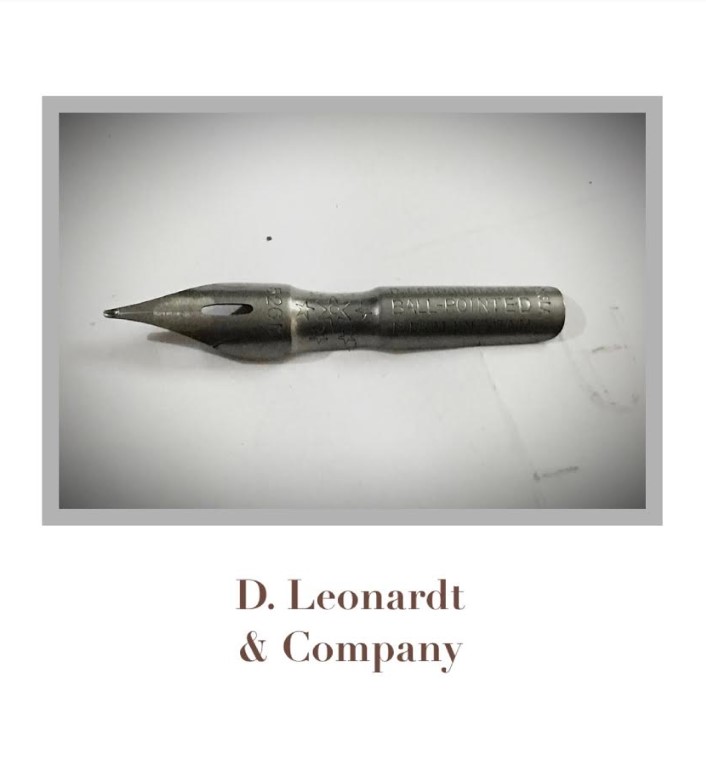
Leonardt Ltd. (formerly D. Leonardt & Co.)  was founded in 1856 by Diedrich Leonardt to manufacture dip pens. They had a large export market in South America and Eastern Europe, and produced pens for the King of Italy. The Co . Patented the  ‘Ballpointed ’ ( the nib with rounded tip ) and also a design named "Automatic Wonder Pen"- an early variety  of fountain pen in 1871.
Though almost all nib manufacturers closed down when the Birmingham boom burst,  , Leonardt & Co survived and  have remained in the industry although the company stopped producing nibs. They now make of metal components for stationery goods.

This heirloom “ Ballpointed” nib is made of nickle , according to their brochure.
——————-


 William Mitchell  started making pen nibs with his brother John Mitchell in the early 1820s and  established his own business in 1825 . The Company became  one of the leading nib manufacturers , famous for lettering pens.
100 years later,  the Company merged with Hinks, Wells & Co , Perry’s and other nib manufacturers to form “British Pens “.
The William Mitchell brand is still around making  art Calligraphy products .

-------------------------------------

MODELS 
Apparently, pen manufacturers vied with one another to innovate and bring out different Models of nibs regularly. 
The names on some of the models found in our family's collection are :
"Relief"  "Red Ink" and "New Metal" 
"Silver Wing , "Ballpointed" and "Pansy"
"Celtic" , "No.88M" and "Selected"
 --------------------------------

Other  items making up the antique  stationery  collection  are : 
PEN STAND 

Wrought Iron Pen  : Artistically made pen stands added a lot of beauty, 'atmosphere' and inspiration to a writing desk. There are a variety of Stands in the collection. This wrought iron sample holds eight pens. 
-----------------------

PAPERCLIP 

Macniven and Cameron Ltd. ( later : Waverley Cameron Ltd.) was a printing and stationery company  in Edinburgh, Scotland. The company was best known for its pen nibs, named “Waverley" nib which was unusual for having an upturned point, which made  the ink flow more smoothly on the paper. The "Waverley" was named in honour of  the Waverley novels written by  Sir Walter Scott .
The Company , which in its later years  manufactured  Paper Clips,   called “Waverly Clips" , closed down in 1964 .

—————————-
PENCILS

 Faber-Castell is one of the world's largest and oldest manufacturers of pens, pencils, other office stationery and Art supplies , luxury writing instruments and leather goods. It is Headquartered in Stein, Germany .
A.W. Faber, the original name of the company, is the oldest company brand in the USA.
The immensely wealthy Noble family were made Barons of Faber in the Kingdom of Bavaria in 1881. ( now, a State in Germany)
 Founded in 1761 , the Company , AW Faber Bleystiftwerke( = “Pencil
works”)  made pencils. The Founder’s granddaughter  married a Count of the Castell-Rudenhausen of N.Bavaria, in 1898. From them originates the new company name,  Faber-Castell. 
 This red and blue pencil carrying the “AW Faber” name is pre-1898.

There are also non branded lead pencils , "Made in Bavaria" .


This is a Copying pencil made by George  Rowney & Co. (Founded in 1783). The Company which was selling perfumes and wigs initially,  started dealing in  paints and Art materials in the 1800s . The Company later diversified into printing and publishing and is still in business .

--------------------------------------
INKWELL 


Inkwells can be great collectibles . The desk bound ones are in cutglass , porcelain and steel. 
"The Traveling Inkwell" : This Design seems to have been  in vogue in Victorian times . Glass bottle with  decorative brass top of tight fitting lid , encased in leather, colour coded ( black and red , according to the ink ) . Made in Austria .

-----------------------------------------------------------
INKSTICKS


Ink sticks or Ink Cakes are a type of solid ink (India ink) used traditionally in several East Asian cultures for calligraphy and brush painting. Inksticks are made mainly of soot or lampblack , carbon from charred pinesticks and animal glue or resin . the inkstick was ground against an inkstone with a small quantity of water to produce  liquid ink .

India ink was first invented in China, three millenia ago . But it was the English who gave it the name  Indian ink .
Indian ink, was also called Chinese Ink ! The sticks or cakes consist of specially prepared lampblack, or carbon black, mixed with a gum or resin .
For commercial use , a binding agent was also added to liquid Indian Ink , making it waterproof and permanent .
During Victorian times, regular liquid inks were also made from iron rust, tree gall etc.

 ------------------------------------------------------------
 SEALING WAX 

Sealing wax is a sealing material used on paper and parchment envelopes  , string or wire knots on parcels  which is difficult to separate without breaking . So it assures the receiver that the consignment was not tampered with before delivery. The sender's identity is usually stamped on it .

Sealing wax was made of primarily , Shellac ( or Laquer , araku ) , certain resins, chalk and colouring matter ( red lead  for Red ) . Other mineral colours were also used for green , blue etc . Shellac is a resin secreted by the Lac Bug , a native insect of India and Thailand.
Sealing wax was generally sold  in the form of sticks. The  stick was held to a flame and when its end started melting and dripping , applied to the closed flap of the envelope and stamped . It hardened very quickly .
---------------------------------------------------------------------
Postal Essentials


 People, back then, wrote long letters, some running into sheaves ! The household needed to be well stocked in envelopes and postage stamps .
 ------------------------------------------------------------------------
LETTER OPENERS 


Letters were not torn open in random fashion. It was a genteeel process, using letter openers !
Letter openers came in a wide variety of materials and embellishments.
Featured here is a Brass Letter-Opener with mosaic work  handle .
Mosaic is the art of creating a coherent design using small bits of colored stone, glass or glazed ceramics . The small bits are called tesserae . They can be irregular in shape or cut according to need and fixed into the base shape ( seen here in the reverse)  with plaster or glue .
Only the word “ Souvenir” is inscribed on this , so country of origin not known .

All stationery went into a chest of drawers or a roll top writing table . But there were times one  also needed to carry pens and stamps and clips to set up a writing space anywhere !


"A Gallery of Indian Domestics"

 Having domestic help ( "Servants" ) is considered feudalistic these days and the practice lingers on only in pockets of third wor...